


Climate change is complicated. There’s the science of it, the politics of it, the ethics of decision-making around it, and its impact on each of us as individuals.
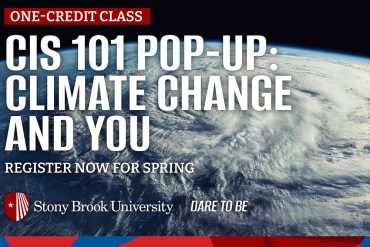
This spring, Stony Brook University students are invited to enroll in a one-credit online course designed to help them explore, grapple with, and begin to understand climate change. The asynchronous course will comprise several units, each designed by a leading university climate expert.
“Young people will inherit a warmer, more extreme climate. Stony Brook faculty are engaged in every area of climate change, and we owe it to our current and future students to help them begin to know how to confront the choices they will have to make because of climate change’s far-reaching impact,” said Kevin Reed, associate provost for climate and sustainability programming, chief climate scientist at The New York Climate Exchange and professor at the School of Marine and Atmospheric Sciences. “This course is an innovative pilot that will get us out of our academic homes and into an environment where we can better serve and support our community.”
The one-credit “pop-up” course was designed to empower students to engage with issues of climate change from an interdisciplinary perspective, and to help them begin to understand the trade-offs involved in combatting and adapting to the world’s changing climate. Any student, freshman to senior, may enroll in the course.
The course, CIS 101, Pop-Up: Climate Change and You, will run the second half of the spring semester, starting March 24, 2025.
Another similar pop-up course focused on artificial intelligence is in development.
“These theme-based classes about climate change, AI and someday other timely and critical issues offer a different way of learning,” said Rose Tirotta-Esposito, director of the Center for Excellence in Learning and Teaching (CELT). “Our curriculum designers were excited to support faculty in creating this online asynchronous class that empowers students to fully engage with the subject.”
The course consists of seven different themes, each designed and guided by a different faculty member.
In addition to Reed and the instructional design team at CELT, seven Stony Brook faculty helped develop the course:
- Rasheed Davis, clinical assistant professor in the School of Health Professions Physician Assistant Program
- Gary Halada, associate professor in the College of Engineering and Applied Sciences Department of Materials Science and Chemical Engineering
- Wenbo Li, assistant professor, School of Communication and Journalism
- Sharon Pochron, assistant professor, School of Marine and Atmospheric Sciences
- Michael Rubenstein, associate professor in the College of Arts and Sciences Department of English
- David Taylor, associate professor, School of Marine and Atmospheric Sciences
- Karina Yager, associate professor, School of Marine and Atmospheric Sciences
“This course represents a truly interdisciplinary approach to a complex challenge we must all face together,” said Carl W. Lejuez, provost and executive vice president. “This course brings together faculty researchers who represent health, communication, science, and engineering and, in only a few weeks, will give students a multifaceted understanding of what may be the most serious challenge of their generation.”
Rather than requiring students to buy a textbook, the course will rely on a variety of materials, including episodes of a podcast produced by the university’s Collaborative for the Earth, “C4E Presents.” Host Heather Lynch, Collaborative director and the endowed chair for ecology and evolution in the Institute for Advanced Computational Science (IACS), brings together Stony Brook scholars and researchers from across campus for interdisciplinary conversations about their efforts in response to climate change.
Full-time students may enroll in the course for free anytime before Friday, February 7, the end of the spring add/drop period.
 Stony Brook Brings AI Expertise to Long Island Small Businesses Through LIA-AI Growth Academy
 Lav Varshney Discusses AI and the Physical Economy of Intelligence
 Two URECA Students Explore Real-World Ideas Through Research
 Stony Brook Researchers Develop a Blueprint for Self-Improving AI


