


Danielle Knapp‑SanGiovanni completed the Master of Social Work program at the State University of New York at Stony Brook in 2020 and began her journey as a social worker, applying the values and ethics of social work as the foundation of her career. Knapp‑SanGiovanni and her partner, also a Stony Brook alumna, run a consulting firm together and, in 2025, were contracted by the Assigned Counsel Defender Plan of Suffolk County (18-B) to design and implement its first trauma‑informed program. The objective of the Assigned Counsel Defender Plan is to provide legal representation for individuals in Suffolk County who cannot afford private attorneys. The organization emphasizes interdisciplinary defense and court services designed to address the broader personal and social issues affecting individuals involved in the legal system. With two Stony Brook MSW interns helping to shape the work from the ground up, the initiative has grown into a full circle of alumni and students strengthening the county’s support system through the lens of forensic social work.
Finding Direction in Social Work
Knapp‑SanGiovanni was working as an art therapist in an inpatient psychiatric unit when she decided to pursue her MSW at Stony Brook. “I loved what I was doing, but it just felt very singular,” she said. “I felt pulled toward a broader way of supporting clients.” Working alongside social workers, many of them Stony Brook graduates, showed her how expansive the field could be. “It really opened my eyes to what social work can do, and how you can assist people in every aspect of their life.”
After graduating, Knapp‑SanGiovanni began gaining supervised clinical experience, taking the next steps toward independent licensure as a psychotherapist. She worked in a private practice while completing the rigorous path from LMSW to LCSW, and now has a small trauma‑focused private practice of her own.
Her experience at Stony Brook reshaped how she understood people and practice, and uncovered an openness and curiosity. Driven by that curiosity, she pursued eye movement desensitization and reprocessing (EMDR) certification as well as a trauma‑informed clinical practice course at NYU, despite not knowing exactly where the path would lead. “I wasn’t sure what it would become,” she said, “but I knew it was something I wanted to incorporate into whatever came next.”
Building a Trauma‑Informed Program Together
Trauma kept presenting itself in Knapp‑SanGiovanni’s clinical work — in private practice, in the stories clients carried and in the gaps she saw in available support. “Trauma is something a lot of us share,” she said. “I saw it as a theme everywhere.” Around the same time, the 18-B program was interested in building a trauma‑informed model for clients navigating the criminal justice system and approached her partner with the idea. “I knew I wanted to incorporate trauma‑informed practice into something bigger,” Knapp‑SanGiovanni said. “When this opportunity came, I thought, this is new, this is needed — let’s try it.”
Over the next year, the pair conducted qualitative and quantitative research to understand the specific needs of individuals represented by the Assigned Counsel Defender Plan of Suffolk County. From that research, Knapp‑SanGiovanni analyzed the data to identify targeted areas of concern and linked those needs to resources across the county. Those connections were then transformed into a geographic information system-based tool that generates individualized referral plans for each client. They also built relationships with mental health organizations, substance‑use agencies and other nonprofits to ensure a trauma‑informed system of support. An intake process, assessment tools and a conversational framework for understanding client needs helped establish the foundation of what is now the Trauma‑Informed Program (TIP) at the Assigned Counsel Defender Plan of Suffolk County.
“A lot of clients have no idea these resources exist,” Knapp‑SanGiovanni said. “We’re connecting them to what they identify as needs, and empowering them to gain access.” Today, their work spans courtrooms and office days: meeting clients with their assigned attorneys, conducting culturally humble intakes and listening to their clients’ narratives in a safe and unjudgmental manner.
Training the Next Generation
Bringing Stony Brook School of Social Welfare students into the TIP program felt like a natural extension of the work. Knapp-SanGiovanni remembered how formative her own internships had been, and she wanted to offer that same kind of grounding experience to emerging social workers. After connecting with School of Social Welfare Assistant Dean Dina Pilgrim, DSW, LMSW, Knapp-SanGiovanni quickly realized the partnership was a perfect fit.
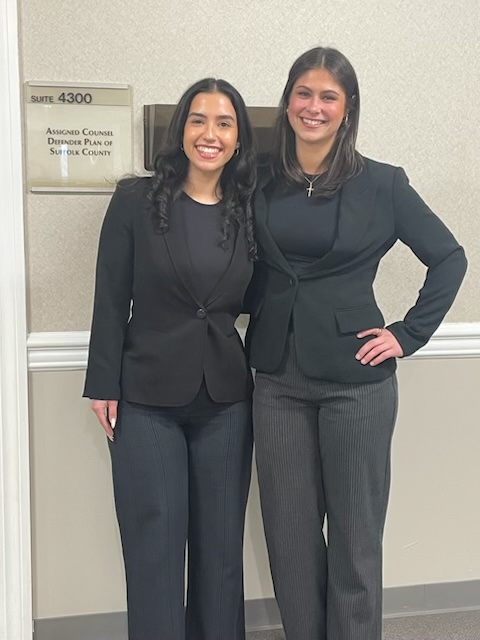
“This program checks so many boxes that Stony Brook stands for — social justice, supporting people who’ve faced oppression, helping clients access what they need,” Knapp‑SanGiovanni said. With Pilgrim’s support, the collaboration came together seamlessly, and soon Amanda Charalambous ’25, MSW ’26 and Isabella Koudelka ’25, MSW ’26 joined the team. “We were so grateful and honored that Stony Brook was just as excited as we were,” she said. “Amanda and Bella are the best. I can’t imagine establishing this program without them.”
What began as careful, gradual training quickly transformed into something more powerful. By winter, the students were operating with independence, presenting trauma‑informed practice to more than 100 attorneys, leading client conversations and representing the program with confidence.
“It’s almost like I follow them now,” Knapp‑SanGiovanni said. “I just watch and I’m in awe of how they communicate our services and provide that initial sense of comfort and trust.” One moment in particular stayed with her: An attorney shared that a resistant client finally agreed to a substance‑use evaluation because of the students’ persistence and rapport. “They’re making such meaningful impacts,” she said. “They’re proud of their growth, and I’m so proud of them.”
As of their May 2026 graduation from the MSW program, both Charalambous and Koudelka have been hired by the Assigned Counsel Defender Plan of Suffolk County as two full-time forensic social workers overseeing the needs of clients in criminal and family court.
“As an alumna, Danielle brings our mission to life through her trauma‑informed leadership, her lived commitment to social justice and the extraordinary mentorship she provides to her student interns,” said Shari Miller, PhD, MSW, dean of the School of Social Welfare. “Watching her guide Amanda and Isabella as they step into this work — and seeing the impact they are already making — is a powerful full‑circle moment for our school.”
Looking Ahead
Knapp‑SanGiovanni and her partner are already preparing to welcome the next cohort of Stony Brook students, continuing a model that has become central to the TIP program’s success. “They have to come in with trauma‑informed practice behind them,” she said. “It’s really the foundation of everything we do.” Even as the program grows, Knapp‑SanGiovanni is deepening her own expertise. She was recently accepted into the doctoral program at NYU, where she plans to focus her research on the TIP program and its impact.
When asked what she would say to others considering giving back to Stony Brook, her answer was simple: “Don’t hesitate, just do it.” And for her, the connection runs deep. “Stony Brook was just an amazing place for me, not only to get my education, but to connect with professionals who have become incredible collaborators, along with these wonderful students. It’s been a continuing relationship that I’m eternally grateful for.”
-Christine McGrath
 Engineering a Path from Stony Brook to the Skies: Zahraa Stuart’s Journey
 From Stony Brook to the Stars: Aditya Upadhyay ’25 Launches Call a Satellite
 Alumnus Kunchok Dorjee Works to Curb Spread of Tuberculosis in His Homeland
 Brandon Axelrod, DDS ’25 Seeks to Bring Compassion and Excellence to Oral Surgery Patients

