


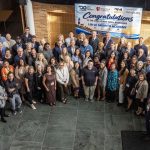
The Advanced Education Research and Technology Center (AERTC) hosted a visit by the SUNY Research Foundation leadership on October 7. Photo by John Griffin.
The Research Foundation for the State University of New York (SUNY RF) leadership enjoyed a behind-the-scenes look at some of the latest research being conducted at the State University of New York at Stony Brook, including the Advanced Education Research and Technology Center (AERTC) and the College of Engineering and Applied Sciences.
Stony Brook hosted a Research Foundation Board of Directors meeting on October 7 and 8 at the Charles B. Wang Center. The foundation’s volunteer board oversees how the Research Foundation supports SUNY researchers so they can focus on research, discovery and innovation.
The visit provided a unique opportunity to showcase some of Stony Brook’s research strengths and share how the university is preparing its research enterprise for what comes next, according to Mónica Bugallo, interim vice president for research and innovation.
“The university recently launched its ASPIRE 2035 strategic plan, and today you will hear about other areas where we are playing a leadership role, including clean energy and artificial intelligence,” said Bugallo, also a professor of electrical and computer engineering in the College of Engineering and Applied Sciences. “For those of us in the Office for Research and Innovation (OR&I), this is an incredibly exciting moment. The plan sets a bold ambition and will significantly grow the Stony Brook Research and Innovation Enterprise and the impact that we can have in New York and beyond.”

Stony Brook, a renowned R1 research facility and a member of the Association of American Universities, is at the forefront of many cutting-edge research initiatives, including the U.S. Department of Energy’s national AI-for-science Genesis Mission, and its state-of-the-art Quantum Watchtower, which successfully transmitted light particles containing quantum information through open air to Brookhaven National Laboratory.
“Every time I visit a SUNY campus, I am reminded that some of our most valuable insights come from conversations with the faculty, researchers, staff and students who advance SUNY’s mission every day. Those discussions help shape how we strengthen support for research and scholarship across the system and ensure SUNY’s research enterprise continues to grow,” said SUNY Executive Vice Chancellor for Academic Affairs and Provost Melur K. “Ram” Ramasubramanian, president of SUNY RF. “Visiting the Advanced Energy Research and Technology Center highlighted the extraordinary research taking place at Stony Brook and the importance of the support systems that make that work possible. The Research Foundation is proud to provide the talent, services and technology that enable SUNY researchers to focus on discovery, innovation and student success.”
At the AERTC complex, William Stewart, a professor in the Department of Mechanical Engineering, highlighted an Office of Naval Research-funded robotics research program for autonomous operation in turbulent coastal environments.

Stewart explained that there is unexploded ordnance in a variety of beachfront areas, left by the Navy. “Sending in divers would be dangerous. So we want to send robots into these surfy, turbulent waters that are constantly churning and changing.”
Realistic test environments allow these air drop robots to learn and be tested before they are deployed in the real world. “So we are building such a facility here at Stony Brook.”
Stewart added that general robots with jet thrusters are not fast enough and are unable to adjust their trajectories and torques quickly enough to be able to react to the changing environments.
“Instead, we’re looking at ‘crab robots,’” he said. “Crabs have little legs, they walk around, and they’ve got little swimmerets that they use to swim. We think that by adopting such a modality, we can improve the robots operating in the surf. Having the robots swim in and learn in our facilities will allow us to better prepare the robots for the ocean.”
Empire Innovation Associate Professor Fang Luo and Derek O’Connor, senior manager for workforce development at OR&I, introduced the Spellman High Voltage Power Electronics Laboratory and Power Systems Training Lab, where students and workers are prepared with the practical skills needed to operate and support the increasingly complex electric power systems of the future.

This lab has 30 graduate students and 36 active projects, with partnerships across federal agencies, state agencies and industry. Applications span modern grids, AI data centers, electric aircraft, marine systems, offshore wind, hydrogen, hybrid energy storage and interoperability testing.
“The lab I oversee includes all the hardware development as well as algorithm development covering power electronics and modern electrical power system conversions,” said Luo. “We focus on delivering a vertically integrated research spectrum here, starting from the post-processing of powers and conductors all the way through to systems.”
O’Connor addressed the work being done to develop the workforce of the future.
“Who is going to do the work with these machines and this research, and apply all the technology that they’ve been learning about into the real world?” asked O’Connor. “We’re going to need expertise to help keep the grid stable as we move toward our electrification goals. And that’s where the work we do here at Stony Brook is important.”
Closing out the tour, associate professor Dimitris Assanis in the Department of Mechanical Engineering showcased Stony Brook’s work in advanced energy systems and high power, developing and testing new ways to produce, store and use energy more efficiently.

Assanis is the founding director of the Advanced Combustion & Energy Systems (ACES) Laboratory, which researches ammonia and hydrogen combustion, digital-twin simulation, diesel efficiency with lower emissions, hydrogen production from air and alternative fuels.
Attendees got an inside look at a research laboratory developing carbon-free combustion, hydrogen infrastructure and alternative-fuel technologies from fundamental research through field demonstrations.
“Fewer than a dozen laboratories worldwide can perform the type of testing we’re doing,” said Assanis. “This is what a modern internal combustion engine laboratory looks like today. They are clean, and we are looking for ways to move past fossil fuels. If you want carbon-free combustion, you can achieve it through hydrogen or through ammonia, but the challenges are not easy.”
Assanis then spoke about a linear generator using 100-percent hydrogen that will be dispatched at Long Island’s Northport Power Plant for a 12-month pilot, and led a tour of the lab’s mobile command center trailer.
“These three labs are very different, but together they tell a very important Stony Brook story: cutting-edge research, workforce development, partnership and innovation coming together to address problems that really matter,” Bugallo said.
The tours were preceded by three lightning talks: one by Toni Foster on the new RAISE Traineeship, aimed at preparing trainees for entry-level research administration roles, and two covering the Genesis Mission strategic intelligence and proposal development, delivered by Jawaad Sheriff and Kai Sherman, respectively.
— Robert Emproto
 Ecology and Evolution Alumni Explore Bat Longevity
 Pufferfish, Crabs and a Boatload of Discovery on Shinnecock Bay
 Stony Brook Brings AI Expertise to Long Island Small Businesses Through LIA-AI Growth Academy
 Lav Varshney Discusses AI and the Physical Economy of Intelligence

